In the world of pastry, accuracy isn’t just a preference — it’s the difference between a soaring soufflé and a dense leaden disc.
While home recipes often rely on cups and spoons, professional bakers operate on a single, unwavering truth: Volume is a variable, but weight is a constant.
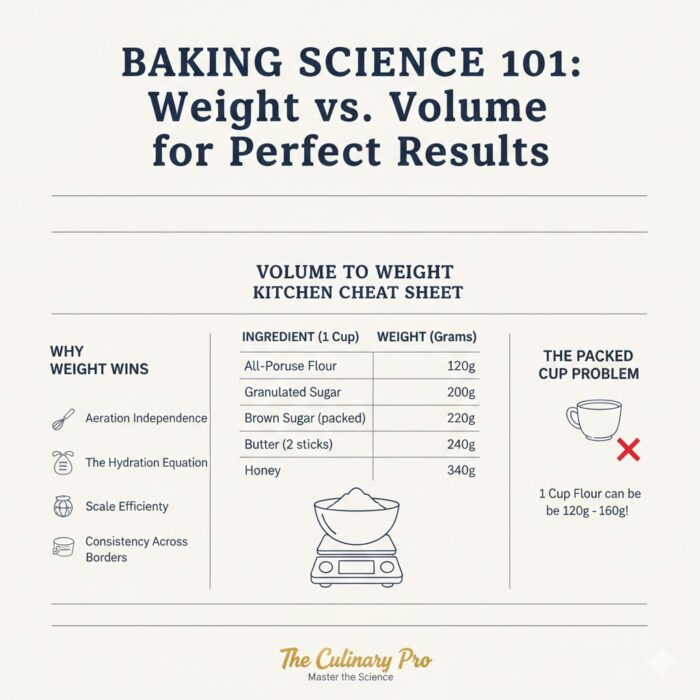
The primary culprit in baking failure is often the “packed cup.” Depending on how you scoop it, a cup of all-purpose flour can weigh anywhere from 120g to 160g.
That 30% variance is enough to ruin the hydration balance of your dough before you even turn on the oven.
Why Weight Wins Every Time
-
Aeration Independence: Flour settles over time. Sifting or packing changes the volume significantly, but 100g of flour is always 100g, regardless of its density.
-
The Hydration Equation: Baking is a series of chemical reactions. For gluten to develop correctly, the ratio of liquid to protein must be exact.
-
Scale Efficiency: Weighing ingredients into a single bowl is faster and creates fewer dishes than using multiple measuring cups.
-
Consistency Across Borders: A “cup” can vary in size between the US, UK, and Australia. The gram is the universal language of the global kitchen.
Conclusion
Switching to a digital scale is the single most effective way to improve your baking overnight. When you measure by weight, you eliminate the guesswork and ensure that your results are as repeatable as a laboratory experiment.