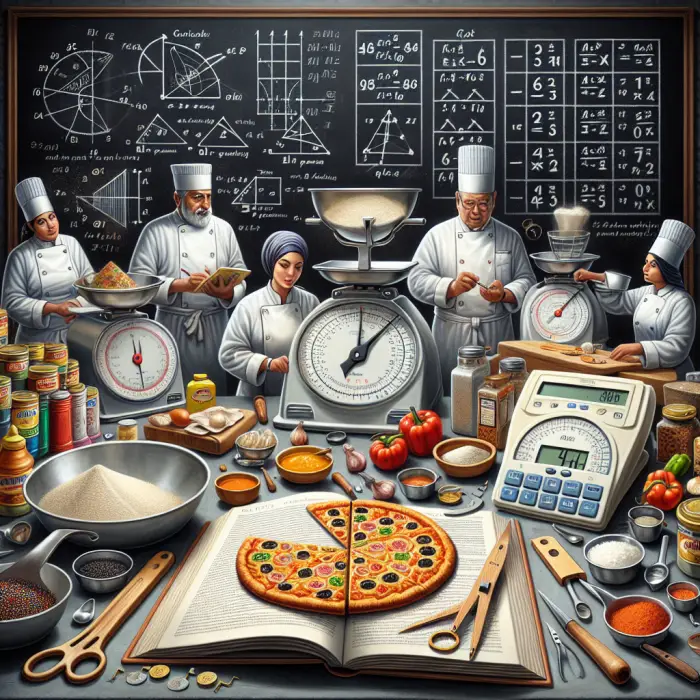
In the high-pressure environment of a professional kitchen, recipes are often discarded in favor of ratios.
While a recipe is a fixed set of instructions, a ratio is a fundamental mathematical relationship between ingredients. Once you master these ten ratios, you stop “following instructions” and start “cooking by intuition.”
The Fundamental Ratios
-
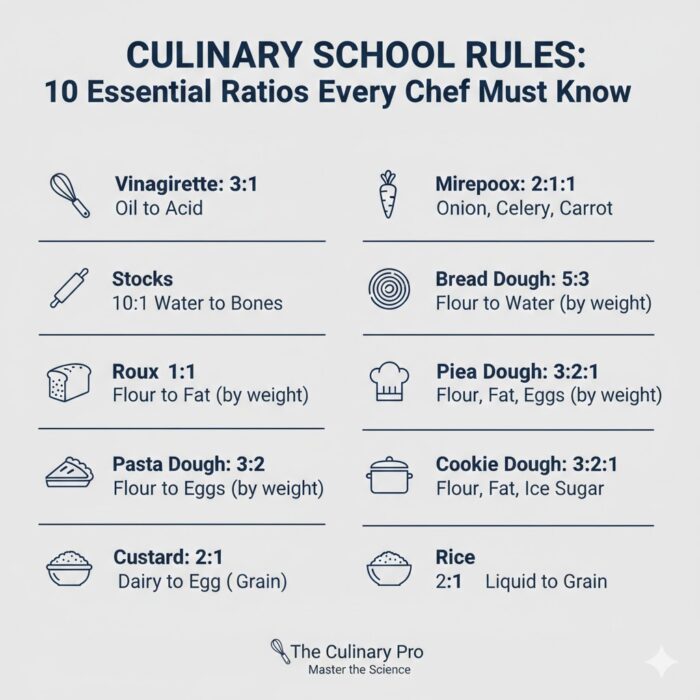
Vinaigrette (3:1): Three parts oil to one part acid. The bedrock of balanced salads.
-
Mirepoix (2:1:1): Two parts onion, one part celery, one part carrot. The aromatic base for countless stocks and stews.
-
Stocks (10:1): Ten parts water to one part bones (plus aromatics).
-
Roux (1:1): Equal parts flour and fat by weight to create the perfect thickening agent.
-
Bread (5:3): Five parts flour to three parts water (roughly 60% hydration).
-
Pasta Dough (3:2): Three parts flour to two parts lightly beaten eggs.
-
Pie Dough (3:2:1): Three parts flour, two parts fat, and one part ice-cold water.
-
Custard (2:1): Two parts liquid (milk/cream) to one part egg by weight.
-
Rice (2:1): Two parts liquid to one part grain (standard long-grain white rice).
-
Beurre Blanc (2:2:1): Two parts butter, two parts wine/vinegar reduction, one part heavy cream (optional for stability).
Conclusion
Ratios are the “secret language” of culinary school. They allow you to scale recipes instantly for ten or two hundred guests without losing the integrity of the dish. Mastery of these proportions is what transforms a cook into a chef.