Scaling a recipe isn’t as simple as multiplying every ingredient by two. In professional kitchens, successful expansion or reduction requires an understanding of Culinary Science.
When you move from a four-person dinner to a forty-person banquet, physics and chemistry—particularly evaporation rates and leavening power—begin to shift.
The secret to perfect scaling lies in Baker’s Percentages and weight-based ratios.
By converting a recipe into weights rather than volumes, you ensure that the ratio between your “structural” ingredients (like flour) and “functional” ingredients (like water or fat) remains identical, whether you are making one loaf or one hundred.
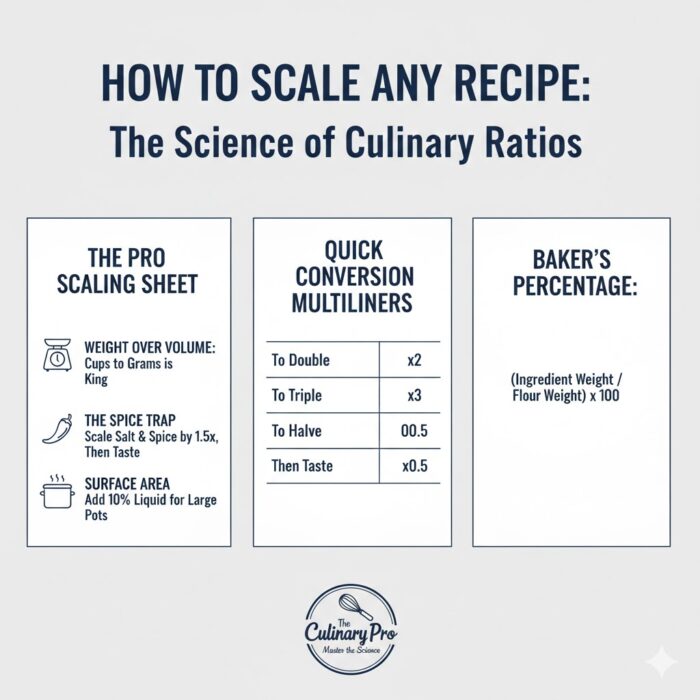
The Pro Scaling Checklist
-
Weight Over Volume: Always convert cups to grams; volume is too variable for large-scale accuracy.
-
The Spice Trap: Do not strictly double “aggressive” ingredients like salt, cayenne, or cloves; scale them by 1.5x first and taste.
-
Surface Area: Larger pots mean faster evaporation. You may need to increase liquids by about 10% when scaling up in wide vessels.
-
The Rule of Multipliers: Use a decimal system (e.g., x2.0 for doubling, x0.5 for halving) to keep your math clean on a prep sheet.
Conclusion
Scaling is where math meets the flame. By focusing on the science of ratios rather than just the numbers on a page, you maintain the flavor profile and texture of your original dish at any volume.